
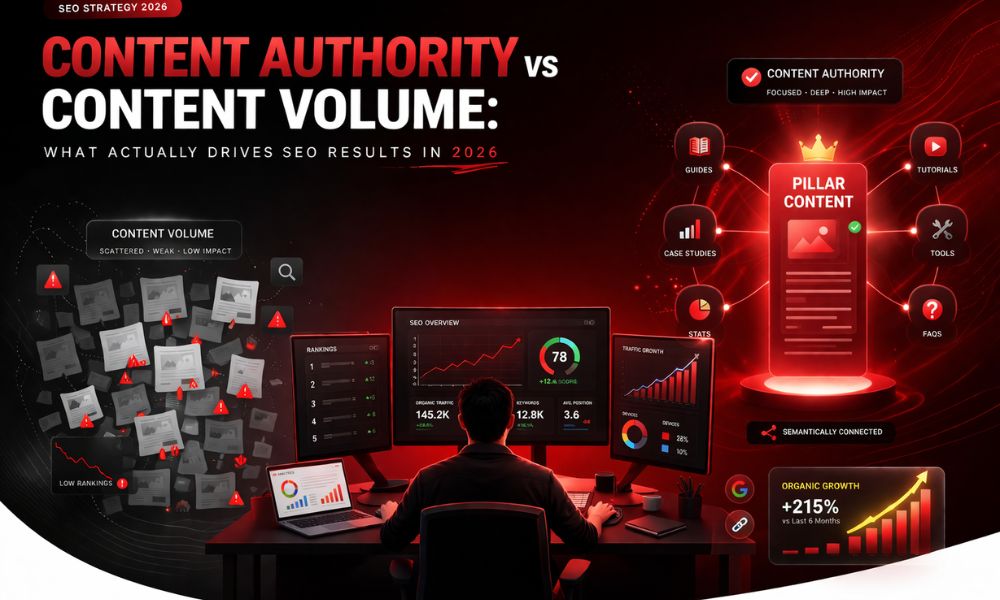
Content authority vs content volume is no longer a debate about preference. It is about performance. Content authority drives rankings, trust, and conversions because it aligns with search intent, semantic search, and user behavior. Content volume increases visibility, but without depth and structure, it rarely produces meaningful results.
Search engine optimization now rewards websites that demonstrate expertise through structured content, clear topical focus, and strong internal connections between pages. The most effective strategy is to build authority first, then scale content in a way that supports that authority.
For years, businesses treated SEO as a numbers game. Publish more pages, target more keywords, and traffic would follow. That worked when search engines relied heavily on keyword frequency.
That is no longer how SEO works.
Today, search engines evaluate how well your content satisfies user intent, how deeply it covers a topic, and how clearly it is structured. They are no longer asking “how much content do you have?” but “how useful is your content?”
A strong example of structured, high-value content can be seen in this detailed website audit checklist for modern SEO
This type of content answers multiple questions in one place, which is exactly what modern SEO rewards.
Understanding Content Authority

Content authority is your ability to become a trusted source within a specific topic. It is built through depth, clarity, and expertise.
Depth Creates Visibility
Authority content goes beyond surface-level answers. It covers related subtopics, questions, and use cases in one structured page.
This allows a single page to rank for multiple search queries instead of creating dozens of thin pages.
Structure Improves SEO Performance
Search engines rely on structure to understand content. Clear headings, logical flow, and organized sections help both users and algorithms.
When your content is structured well, it becomes easier to connect it with other relevant pages on your site.
Real Experience Builds Trust
Authority comes from proof, not just claims. Case studies show real-world performance and results.
For example:
SEO case study showing measurable business growth
This type of content builds credibility and demonstrates expertise in a way that generic blogs cannot.
Intent-Driven Content Wins
Every search has intent. Some users want answers, others want comparisons, and some are ready to take action.
Authority content aligns with this intent and guides users toward a decision.
Understanding Content Volume

Content volume focuses on publishing a large number of pages to increase keyword coverage.
Where Content Volume Works
Content volume is useful when targeting multiple variations of a topic, especially in local SEO.
For example:
Creating optimized local landing pages for search visibility
This approach helps capture location-based searches effectively.
The Problem With Volume-Only Strategies
Publishing content without depth leads to:
- Repetitive topics
- Low engagement
- Poor conversions
Search engines now prioritize usefulness, not just quantity.

Content Authority vs Content Volume: Key Differences
| Factor | Content Authority | Content Volume |
|---|---|---|
| Focus | Depth and expertise | Quantity |
| Goal | Trust and conversions | Traffic |
| SEO Impact | Long-term growth | Short-term visibility |
| Engagement | High | Low to moderate |
| Sustainability | Strong | Weak without structure |
How Search Engines Evaluate Content Today

Search engine optimization has evolved significantly.
Search Intent Matters Most
Search engines prioritize content that directly answers user queries.
A deeper understanding can be seen here:
How buyer intent impacts SEO performance
Semantic Search Improves Relevance
Search engines understand context and relationships between topics. This means content should focus on meaning, not just keywords.
Content Depth Improves Rankings
A single, well-structured page can outperform multiple short pages because it provides complete answers.
Engagement Metrics Influence SEO
User behavior signals quality. Metrics like time on page and bounce rate matter.
Site performance also plays a role: How website speed impacts SEO and conversions
Why Content Authority Wins in 2026
Builds Long-Term Trust
Users trust content that consistently delivers value.
Ranks for More Keywords
Authority content naturally ranks for multiple keyword variations.
Performs Better in AI Search Results
AI-driven search systems prioritize structured, high-quality answers.
Where Content Volume Still Matters
Content volume is not useless. It just needs to support authority.
Supporting Content Strategy
Smaller pages can target specific queries and link back to core topics.
Content Freshness
Regular updates signal that your website is active and relevant.
The Best Strategy: Authority First, Then Scale
The most effective SEO strategy combines both approaches.
Build Strong Core Content
Start with in-depth pages that define your expertise.
Expand Strategically
Support your core content with related topics.
Example:
Future of AI in digital marketing
Use Internal Linking Naturally
Internal linking helps search engines understand relationships between pages.
Relevant services should connect naturally with content, such as:
SEO services for long-term business growth
and
Custom website development solutions
Focus on User Experience
Good design improves engagement and rankings.
Example:
Modern web design trends for performance and usability
External References That Support This Strategy
Search engines themselves emphasize content quality and usefulness.
- Google helpful content guidelines
- SEO fundamentals explained by Moz
- Content SEO strategies by Ahrefs
Common Mistakes to Avoid

- Publishing content without strategy
- Focusing only on keywords
- Ignoring internal linking
- Prioritizing quantity over quality
The Future of SEO
SEO is evolving toward:
- AI-driven search
- Intent-based ranking
- Authority-focused content
Websites that invest in structured, high-quality content will continue to win.
Conclusion
Content authority vs content volume is no longer a matter of preference. It is a decision that directly impacts rankings, traffic quality, and conversions.
Content volume can increase visibility, but content authority drives meaningful results. Businesses that focus on depth, structure, and intent consistently outperform those chasing quantity.
At Red Rattler Creative, the focus is on building authority-driven strategies that combine structured content, smart internal linking, and real expertise. This approach ensures long-term growth, stronger search visibility, and measurable business outcomes.
FAQs
What are the 4 types of SEO?
The four types of SEO are on-page SEO, off-page SEO, technical SEO, and local SEO. Each focuses on different aspects of improving search visibility and website performance.
What are the 4 types of content?
The four main content types are informational, navigational, transactional, and commercial. Each type serves a different stage of the user journey.
What is the 80/20 rule for SEO?
The 80/20 rule in SEO means that a small percentage of high-quality content drives the majority of traffic and results. Focusing on key pages delivers the highest impact.
Is SEO dead or evolving in 2026?
SEO is evolving, not dying. It is shifting toward intent-based search, AI-driven results, and authority-focused content strategies.
What are the 3 C’s of SEO?
The 3 C’s of SEO are content, code, and credibility. These represent quality content, technical performance, and trust signals.
What are the 4 pillars of SEO?
The four pillars of SEO are content, technical SEO, on-page optimization, and off-page authority.
Can ChatGPT do SEO?
ChatGPT can assist with content creation, keyword research, and optimization, but human expertise is required for strategy and quality control.
Is SEO being phased out?
SEO is not being phased out. It is becoming more advanced, focusing on user intent, structured content, and authority.