Many small business owners assume Google Ads is a game won by whoever spends the most money.
That’s not how it works.
In reality, a local roofing company with a $1,500 monthly budget can outperform a competitor spending $10,000 if it appears in front of the right customer at the right moment.
The difference isn’t usually the budget.
It’s intent.
Google Ads works because it allows businesses to reach people precisely when they are looking for a solution. Someone searching for “emergency AC repair near me” is fundamentally different from someone scrolling social media after dinner. One is actively trying to solve a problem. The other may not even know they have one.
The businesses that understand this distinction often generate better leads, lower acquisition costs, and higher returns, even with modest advertising budgets.
Why Some Small Businesses Lose Money With Google Ads
Google Ads gets blamed for many failed campaigns.
In reality, the platform is rarely the problem.
Most campaigns struggle because businesses focus on visibility before profitability.
A common scenario looks like this:
- Broad keywords
- Generic ads
- Homepage traffic
- No conversion tracking
- No negative keywords
- No landing page strategy
The result?
Traffic increases.
Revenue doesn’t.
The problem is that clicks feel productive, but clicks are not customers.
Every decision inside a Google Ads account should ultimately answer one question:
Will this help attract a customer who is likely to buy?
If the answer is unclear, the budget is probably being wasted.
Start With Search Intent, Not Keywords

Most Google Ads advice starts with keyword research.
The better starting point is understanding intent.
For example, consider these searches:
| Search Query | Likely Intent |
| What is Google Ads? | Learning |
| Google Ads tips | Researching |
| Google Ads for small business | Evaluating |
| Google Ads management services | Ready to buy |
Each search represents a different stage of the customer journey.
Yet many advertisers target all of them with the same campaign.
Businesses often see stronger results when campaigns are built around high-intent searches first and informational searches later.
This is the same principle that drives successful organic search strategies. Understanding how people search and why they search often matters more than search volume alone.
The Fastest Way to Improve Results: Stop Paying for the Wrong Searches

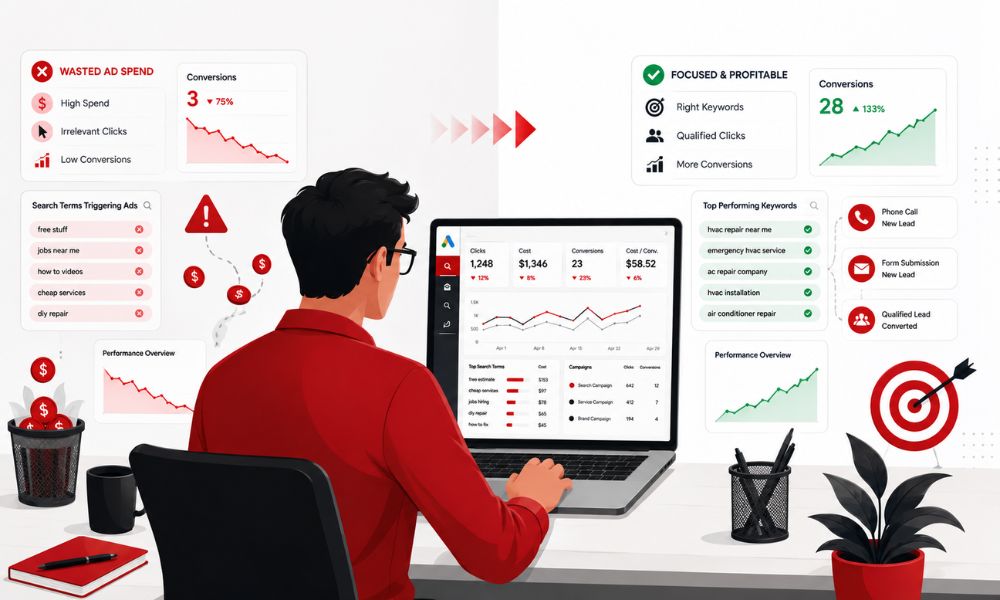
Most small businesses are surprised when they discover where their ad budget is actually going.
Search term reports often reveal clicks coming from searches like:
- Free
- Jobs
- Careers
- DIY
- Training
- Tutorial
- Certification
A company selling professional services does not need traffic from people looking for employment opportunities or free resources.
This is why negative keywords are one of the highest-return optimizations available.
In many cases, adding a strong negative keyword list reduces wasted spend faster than increasing bids or adjusting budgets.
Local Businesses Have an Advantage, Larger Brands Don’t

National companies have bigger budgets.
Local businesses have something more valuable.
Relevance.
When somebody searches:
“plumber near me”
“roof repair in San Antonio”
“AC repair open now”
Google wants to show the most relevant solution.
This creates an opportunity for smaller businesses to compete effectively against larger advertisers.
A strong local strategy should include:
- Geographic targeting
- Service-area campaigns
- Local landing pages
- Location assets
- Consistent business information
Businesses that combine paid search with local visibility often create stronger long-term results than relying on advertising alone.
Why Most Small Business Landing Pages Fail

Imagine searching for:
“Emergency HVAC repair”
You click an ad.
Instead of finding repair services, you’re sent to a homepage discussing the company’s history, mission statement, and team members.
Most visitors leave immediately.
This happens every day.
The landing page should continue the conversation started by the search.
If the search was about AC repair, the landing page should focus entirely on AC repair.
If the search was about website design, the landing page should focus entirely on website design.
Message alignment improves:
- Conversion rates
- Lead quality
- Quality Score
- Cost efficiency
Website experience matters more than many advertisers realize. Slow websites, confusing navigation, and poor mobile usability can quietly destroy campaign performance.
Should Small Businesses Use Performance Max Campaigns?

Many advertisers hear about Performance Max and assume newer automatically means better.
Not always.
Performance Max can be extremely effective once a business has:
- Reliable conversion tracking
- Historical campaign data
- Clear customer signals
- Proven offers
Without those foundations, automation may simply accelerate inefficient spending.
For many small businesses, Search campaigns remain the most predictable starting point because they provide greater control over keywords, search intent, and budgets.
Measure Revenue, Not Traffic

Traffic is easy to measure.
Revenue is what matters.
A campaign generating 50 qualified leads is more valuable than one generating 5,000 visitors.
Instead of focusing primarily on:
- Impressions
- Clicks
- Reach
Track:
- Calls
- Form submissions
- Booked consultations
- Purchases
- Revenue generated
According to Google’s advertising documentation, conversion tracking is one of the most important components of campaign optimization because it allows advertisers to identify which actions contribute to business outcomes.
Do Google Ads Work for Small Businesses?
Yes.
But not because Google Ads magically creates customers.
It works because it connects businesses with people who are actively looking for solutions.
The businesses that perform best are usually not the ones spending the most.
They’re the ones that:
- Understand customer intent
- Eliminate wasted clicks
- Build relevant landing pages
- Track conversions accurately
- Continuously optimize based on data
Google Ads rewards relevance more than size.
That’s good news for small businesses.

Wrapping Up..
Google Ads can be one of the most effective ways for small businesses to generate leads and sales, but success depends on more than budget. Businesses that focus on customer intent, local targeting, conversion tracking, and relevant landing pages often achieve better results than competitors spending significantly more.
The goal isn’t simply to get more clicks. It’s to attract the right customers at the right time and turn that interest into measurable business growth.
If you’re looking to improve campaign performance, reduce wasted ad spend, or generate more qualified leads, Red Rattler Creative can help you build a Google Ads strategy focused on real business results.
Frequently Asked Questions
Do Google Ads work for small businesses?
Yes. Google Ads can be highly effective for small businesses because it targets people actively searching for products and services. Businesses that focus on intent, conversion tracking, and local targeting often achieve stronger results than businesses focused solely on traffic.
What is the best Google Ads strategy for small businesses?
The most effective strategy typically combines high-intent keywords, negative keywords, location targeting, conversion tracking, and landing pages designed around a specific customer need.
How much should a small business spend on Google Ads?
Budgets vary by industry, competition, and customer value. Rather than choosing a budget first, businesses should determine how much a lead or customer is worth and work backward from that number.
What are the best Google Ads tips for beginners?
Start with Search campaigns, use negative keywords immediately, focus on a specific service area, track conversions from day one, and optimize landing pages for the searcher’s intent.
Do Google Ads help local businesses?
Yes. Google Ads is particularly effective for local businesses because campaigns can target specific cities, neighborhoods, and service areas where customers are actively searching for nearby solutions.
Are Google Ads and Google AdWords the same thing?
Yes. Google AdWords was rebranded as Google Ads. The platform still serves the same purpose but now includes Search, Display, YouTube, Shopping, and other advertising formats.