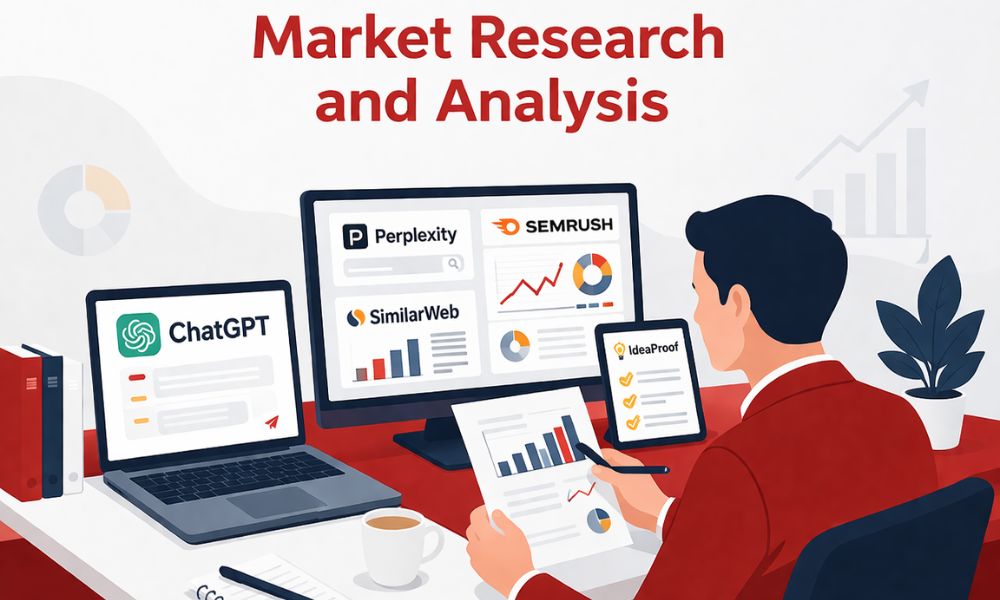
Best AI for market research and analysis in 2026 depends on your specific use case, not just the tool.
- Use ChatGPT for strategy, synthesis, and planning
- Use Perplexity AI for real-time research and cited insights
- Use SparkToro or GWI Spark for audience intelligence
- Use Crayon for continuous competitor monitoring
- Use Tableau or Zebra AI for data visualization and reporting
- Use IdeaProof for fast market validation
The most effective approach is to combine multiple AI tools for marketing to cover research, analysis, validation, and execution together.
What This Guide Covers
This guide is built for marketers, founders, agencies, and product teams who want to choose the best AI tools for market research and analysis.
By the end, you will understand:
- Which AI tools are best for different use cases
- How to choose the right tool based on your needs
- What each tool does well and where it falls short
- How to actually implement AI in your workflow
Instead of just listing tools, this guide focuses on helping you make the right decision.
Why AI for Market Research Is a Game-Changer in 2026

AI for market research has completely changed how businesses make decisions. What once required weeks of manual work can now be done in hours with the right tools.
Modern AI tools for marketing can process massive datasets, uncover patterns, and provide clear recommendations. This is especially valuable when paired with a strong digital foundation, like a well-structured website built through professional website development, where insights can be quickly implemented.
Another major shift is speed. Businesses no longer need to wait for static reports. Instead, they can continuously analyze and adapt based on real-time data.
What Makes the Best AI Marketing Tools Stand Out
Not all AI marketing tools are built the same. The best tools share a few key traits that directly impact results.
Real-Time Data Access
Tools that connect to live data sources provide more accurate insights. Platforms like Google Trends show how demand shifts over time, which helps validate ideas quickly.
Deep Data Analysis
Strong tools go beyond surface insights. They analyze customer behavior, competitor strategies, and market trends.
Automation
AI marketing automation tools reduce repetitive work and allow teams to focus on strategy.
Multi-Source Intelligence
Top tools combine data from search engines, social platforms, and analytics tools.
Actionable Insights
The goal is not just data, but decisions. The best AI tools help you act faster and smarter.
Types of AI Market Research Tools
Not all AI tools serve the same purpose. Here’s how they break down:
1. AI Assistants (Strategy & Synthesis)
Used for summarizing data, generating insights, and building strategies.
Examples: ChatGPT, Claude
2. Competitive Intelligence Tools
Track competitors, pricing, positioning, and market movement.
Examples: SimilarWeb, Crayon, SEMrush
3. Trend & Audience Research Tools
Analyze demand, search trends, and audience behavior.
Examples: Google Trends, SparkToro
4. Customer Feedback & Sentiment Analysis Tools
Analyze reviews, surveys, and qualitative data.
Examples: Zappi, MonkeyLearn-style tools
5. Market Sizing & Validation Tools
Estimate TAM, SAM, SOM and validate ideas.
Examples: IdeaProof
6. Data Visualization & BI Tools
Turn data into dashboards and reports.
Examples: Tableau
7. Web Scraping & Data Extraction Tools
Collect product, pricing, and competitor data at scale.
Examples: Apify, Octoparse (category mention for completeness)

10 Best AI Tools for Market Research and Analysis (2026)
Comparison Table
| Tool | Category | Best For | Key Strength | Ideal User | Pricing |
|---|---|---|---|---|---|
| IdeaProof | Validation | Market sizing | Fast insights | Startups | Free |
| Perplexity | Research | Real-time data | Citations | Marketers | Free/Paid |
| ChatGPT | Assistant | Strategy | Deep analysis | All teams | Free/Paid |
| SEMrush | Competitive | SEO + market data | Keyword insights | Agencies | Paid |
| SimilarWeb | Competitive | Traffic analysis | Audience data | Growth teams | Paid |
| Statista | Data source | Industry stats | Verified data | Enterprises | Paid |
| Google Trends | Trends | Demand analysis | Real-time trends | Everyone | Free |
| Crayon | Intelligence | Competitor tracking | Monitoring | Sales/Product | Paid |
| Tableau | BI | Visualization | Dashboards | Analysts | Paid |
| Notion AI | Workflow | Organization | Centralization | Teams | Paid |
Deep Dive Into the Best AI Tools
ChatGPT
Category: AI Assistant
Best for: Strategy, analysis, and idea generation
What it does well:
- Synthesizes complex information quickly
- Helps build strategies and frameworks
- Great for brainstorming and research
Limitations:
- Does not access proprietary real-time data directly
- Requires validation from other tools
Ideal for: Marketers, founders, strategists
Perplexity
Category: Research AI
Best for: Real-time research with sources
What it does well:
- Provides cited answers
- Pulls from live web data
- Faster than traditional research
Limitations:
- Not built for deep analytics or dashboards
Ideal for: Researchers, content teams
SEMrush
Category: Competitive + SEO
Strengths:
- Keyword and competitor analysis
- Search intent insights
Limitations:
- Focused mainly on digital marketing
- Expensive for small teams
Ideal for: Agencies, SEO teams
SimilarWeb
Category: Competitive Intelligence
Strengths:
- Website traffic insights
- Audience demographics
Limitations:
- Less accurate for smaller websites
- Expensive
Ideal for: Growth and strategy teams
IdeaProof
Category: Market Validation
Strengths:
- TAM/SAM/SOM calculations
- Fast validation
Limitations:
- Not built for enterprise-level research
Ideal for: Startups
Best AI Tools by Use Case (New Section)
Best for competitor analysis
SEMrush, SimilarWeb, Crayon
Best for audience research
SparkToro, Google Trends
Best for customer feedback analysis
Zappi, ChatGPT
Best for market sizing
IdeaProof
Best for trend analysis
Google Trends, Perplexity
Best for startups
IdeaProof, ChatGPT
Best for enterprise teams
Tableau, Statista, Crayon
How to Choose the Right AI Market Research Tool
Choosing the right tool depends on your needs. Use this framework:
1. Define your goal
Are you validating an idea, tracking competitors, or analyzing customers?
2. Check data sources
Does the tool pull from search, social, or proprietary databases?
3. Evaluate integrations
Can it connect with CRM, dashboards, or reporting tools?
4. Review AI capabilities
Does it generate insights or just display data?
5. Consider usability
Is it beginner-friendly or requires training?
6. Compare pricing
Free vs subscription vs enterprise pricing
7. Check scalability
Will it work as your team grows?
How to Use AI for Market Research (Step-by-Step)

Step 1: Define Your Goals
Start with clarity:
- Are you validating an idea?
- Understanding competitors?
- Identifying customer needs?
Clear goals lead to better insights.
Step 2: Collect Data Using AI Tools
Use a mix of tools:
- Perplexity for research
- Google Trends for demand
- SEMrush for keywords
Combining multiple tools gives a broader perspective.
Step 3: Understand Customer Behavior
AI tools can analyze reviews, surveys, and feedback to identify patterns.
This helps uncover:
- Pain points
- Preferences
- Buying triggers
These insights are critical when building user-focused experiences, similar to principles discussed in UI vs UX design differences.
Step 4: Analyze Competitors
AI tools make it easier to:
- Identify competitors
- Compare strategies
- Find gaps
This approach aligns with advanced competitor research methods used in digital advertising.
Step 5: Turn Insights Into Strategy
The final step is applying what you learn.
AI helps transform raw data into:
- Marketing strategies
- Campaign ideas
- Growth opportunities
Implementation: How to Adopt AI in Your Workflow
- Start with one use case (like competitor research)
- Run a small pilot project
- Train your team on prompts and tools
- Integrate outputs into dashboards or reports
- Measure impact (time saved, insights generated)
- Expand to other use cases
Key Use Cases of AI in Market Research
Market Sizing
AI tools calculate total market opportunity quickly, helping businesses plan effectively.
Customer Research
AI processes large volumes of feedback to identify patterns that would be difficult to detect manually.
Competitive Intelligence
AI tools track competitor activity and provide insights into their strategies.
Trend Analysis
Understanding trends is essential for staying competitive. Platforms like Google Trends provide valuable data on search behavior.
Content Strategy
AI helps identify what content to create and how to structure it.
This becomes more effective when aligned with modern SEO practices like internal linking and structured content clusters, which are discussed in detail in generative engine optimization strategies.
Best Practices for Using AI in Marketing
Be Specific With Prompts
The more detailed your input, the better the output.
Combine Tools
No single tool provides complete insights.
Validate Data
Always cross-check information, especially when making strategic decisions.
Focus on Strategy
AI supports decision-making but does not replace human thinking.
AI Marketing Trends in 2026

- Real-time insights replacing static reports
- Automated dashboards and reporting
- Predictive analytics becoming standard
- AI moving from analysis to decision support
Common Mistakes to Avoid
- Relying on a single tool
- Not validating AI insights
- Ignoring data quality
- Using AI without clear goals
- Over-automating decisions
Limitations of AI Market Research
- AI cannot fully understand context without human input
- Data bias can affect results
- Some tools lack real-time accuracy
- AI cannot replace strategic thinking
Challenges of AI in Market Research
Data Quality
AI is only as good as the data it analyzes.
Bias
Incomplete data can lead to inaccurate insights.
Over-Reliance
Human judgment remains essential.
How AI Improves Marketing Performance
AI enhances key areas of marketing:
- Search engine optimization
- Paid advertising
- Customer targeting
- Conversion rates
For example, combining AI insights with structured advertising strategies like Google Ads campaigns can significantly improve ROI.
The Future of AI in Market Research
AI is evolving toward deeper automation and smarter decision-making.
Future tools will:
- Generate insights without prompts
- Predict market shifts more accurately
- Integrate seamlessly with marketing platforms
This shift is already visible in how businesses approach digital strategy, especially those focusing on long-term growth and adaptability.

Final Thoughts: Turn AI Market Research Into Real Growth with Red Rattler Creative
AI for market research is no longer just a competitive advantage. It is quickly becoming the baseline for businesses that want to move faster, make smarter decisions, and stay ahead in crowded markets. The tools and strategies covered in this guide show how you can go from raw data to actionable insights in a fraction of the time traditional methods require.
But tools alone are not enough.
The real impact comes from how you connect insights to execution. That means aligning your research with your SEO strategy, your website experience, your ad campaigns, and your overall marketing funnel. When everything works together, AI stops being just a research assistant and becomes a growth engine.
This is where most businesses struggle. They collect data, but they don’t translate it into results.
At Red Rattler Creative, the focus is on turning AI-driven insights into real, measurable outcomes. Whether it is building high-converting websites, running data-backed ad campaigns, or creating SEO strategies that rank and convert, the goal is always the same: growth that you can track and scale.
If you are serious about using the best AI for market research and analysis in 2026, the next step is simple. Start applying what you have learned, refine your strategy with real data, and make sure every insight leads to action.
Because in today’s market, speed and clarity win. And AI gives you both when used the right way.
Frequently Asked Questions
1. What is the best AI for market research and analysis in 2026?
The best AI for market research and analysis in 2026 is a combination of ChatGPT, Perplexity AI, and Tableau.
ChatGPT handles deep analysis and strategy, Perplexity provides real-time data with sources, and Tableau turns complex datasets into visual insights. Using these together creates a complete workflow from research to decision-making.
2. Which AI tools are best for market research and analysis?
Top AI tools include SEMrush, SimilarWeb, ChatGPT, and Perplexity AI.
These tools cover keyword research, competitor insights, traffic data, and strategic analysis, making them essential for a complete market research stack.
3. What are the best AI tools for competitor analysis in 2026?
The best AI tools for competitor analysis are Crayon, SEMrush, and SimilarWeb.
They track competitor strategies, traffic sources, content updates, and positioning, helping businesses identify gaps and opportunities.
4. Which AI tools are best for trend tracking in marketing?
Top tools include Google Trends, Perplexity AI, and SparkToro.
These tools identify emerging trends, seasonal demand, and shifts in user behavior using real-time and historical data.
5. What are the best AI market intelligence tools in 2026?
Leading tools include CB Insights, Crunchbase, and SimilarWeb.
They provide insights into funding, market size, competitor growth, and industry trends.
6. Which AI is best for business research and decision-making?
ChatGPT is the best AI for business research due to its ability to analyze data, generate insights, and simulate strategic thinking.
It works best when combined with real-time tools like Perplexity AI for validation.
7. What are the best AI tools for customer insights?
Top tools include GWI Spark, SparkToro, and ChatGPT.
They analyze surveys, behavioral data, and audience activity to uncover motivations, preferences, and pain points.
8. Which AI tools are best for analyzing customer behavior?
The best tools include Google Analytics, Hotjar, and Tableau.
They track user journeys, engagement patterns, and conversion behavior across websites.
9. What are the best AI tools for market analysis in 2026?
Top tools include Tableau, Power BI, and ChatGPT.
They combine data processing, visualization, and strategic interpretation for complete analysis.
10. What are the best free AI tools for market research?
The best free tools include Google Trends, ChatGPT, and Perplexity AI.
They provide valuable insights without requiring a paid subscription.
11. How do AI-powered market research tools work?
AI tools collect data from multiple sources, analyze patterns using machine learning, and present insights in simple formats.
They automate tasks like data collection, summarization, and trend detection, reducing manual research time significantly.
12. What are the latest AI marketing trends in 2026?
Key trends include real-time insights, predictive analytics, automated dashboards, and hyper-personalization.
AI is shifting from automation to decision-making and strategic recommendations.
13. What are the best AI tools for market sizing?
Tools like CB Insights and Crunchbase help estimate total addressable market (TAM), serviceable market (SAM), and growth potential using industry data.
14. Which AI assistant is best for market research?
ChatGPT is the best AI assistant because it can refine insights, answer follow-up questions, and simulate expert-level reasoning.
15. What are the best AI-powered competitor analysis tools in 2026?
Top tools include Crayon, SEMrush, and Ahrefs.
They track competitors across search, ads, and content strategies.
16. What are the top AI analytics tools for understanding customer behavior?
The best tools are Google Analytics, Hotjar, and Tableau.
They help businesses understand how users interact with websites and what drives conversions.
17. How can businesses integrate AI into market research workflows?
Businesses can integrate AI by using tools for data collection, customer insights, and competitor tracking, then combining outputs into dashboards or reports.
The process should include validation, collaboration, and continuous optimization.
18. What are the best AI tools for audience research and influencer discovery?
Top tools include SparkToro and GWI Spark.
They identify where audiences spend time online and what influences their decisions.
19. Can AI replace traditional market research?
AI cannot fully replace traditional research.
It improves speed and efficiency, but human validation, context, and strategic thinking are still essential for accurate decision-making.
20. What is the future of AI in market research?
The future includes autonomous research agents, predictive analytics, and AI-generated strategies.
AI will move from supporting research to actively guiding business decisions with real-time insights.