
AI will change the future of digital marketing by making campaigns more personalized, predictive, and automated. Businesses will use AI in marketing to analyze customer behavior in real time, deliver tailored content, forecast buying decisions, and optimize ads automatically. Digital marketing strategy will shift from manual execution to intelligent systems that continuously learn and improve performance across channels.
In simple terms, marketing is shifting from guesswork to precision.
By 2030, customers will expect brands to know what they want before they search. Ads will adjust in real time. Websites will change based on who is visiting. Campaigns will run and optimize themselves using AI in marketing.
Businesses that understand this shift early can gain a major advantage. Those who ignore it risk falling behind competitors who use AI to move faster and make smarter decisions.
This guide explores the future of digital marketing, how AI is changing digital marketing today, and what businesses can expect by 2030. You’ll learn how AI is transforming SEO, Google Ads, content automation, website personalization, and customer experiences, along with practical steps to prepare your business for the next generation of AI-powered marketing.
AI Is Becoming the Core of Digital Marketing Strategy

AI in marketing is no longer experimental. It is becoming foundational.
In the past, marketers launched campaigns, waited for results, and adjusted weeks later. That process was slow and often expensive. AI shortens that feedback loop dramatically.
Modern AI marketing tools can:
| AI Capability | What It Does | Marketing Impact |
|---|---|---|
| Data Analysis | Processes massive datasets in seconds | Faster insights and quicker decision-making |
| Pattern Detection | Identifies trends in customer behavior | Helps uncover hidden opportunities and segments |
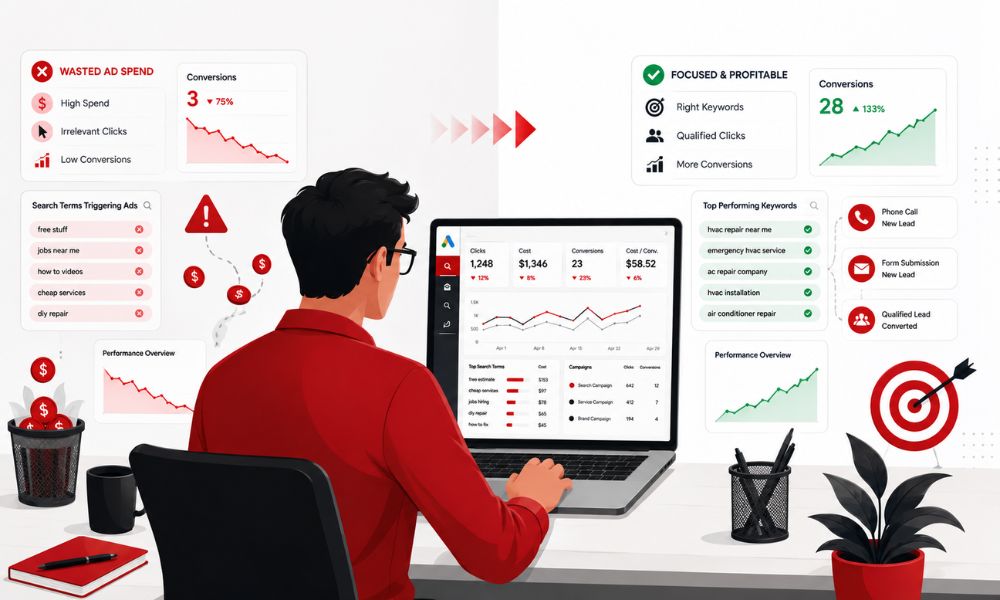
| Conversion Prediction | Estimates which users are most likely to convert | Improves targeting and reduces wasted ad spend |
| Real-Time Optimization | Suggests or applies live campaign improvements | Boosts performance without waiting weeks for results |
Instead of asking what worked last quarter, marketers can ask what will work next week.
This shift also raises the bar for website quality. AI systems rely on clean data and a strong site structure. A fast, well-built site helps AI tools and search engines understand your content better. Businesses investing in solid foundations like professional website development and structured SEO services are better positioned for AI-driven marketing.
AI does not replace strategy. It strengthens it.
What Changes First? The 2026 to 2030 Marketing Roadmap
Digital marketing is no longer experimenting with AI. In 2026, AI is already embedded into platforms, workflows, and reporting. The next four years are about maturity, integration, and intelligence.
2026–2027: Optimization and Integration
- Platforms rely heavily on AI bidding and automation
- First-party data replaces third-party tracking
- CRM, ad platforms, and analytics tools become tightly connected
- Measurement shifts away from last-click attribution
2028–2029: Predictive Intelligence
- Budgets are allocated using predictive performance modeling
- AI forecasts revenue impact before campaigns launch
- Personalization expands across the full customer journey
- Customer lifetime value becomes a core KPI
2030: Autonomous Marketing Systems
- Real-time cross-channel optimization
- Automated audience expansion based on behavior signals
- Dynamic creative adapts instantly to context
- Human teams focus on strategy, brand, and creative leadership
The Future of Content Automation: Trends and Predictions for 2030
One of the biggest shifts shaping the future of digital marketing is content automation. While AI tools already help marketers create outlines, write drafts, and analyze performance, the next few years will transform how businesses manage their entire content lifecycle.
By 2030, content automation will extend far beyond writing blog posts. AI will assist with research, competitor analysis, search intent mapping, content briefs, editing, optimization, translation, and even repurposing content into videos, social posts, podcasts, and email campaigns.
Instead of treating each piece of content as a standalone asset, businesses will build automated content ecosystems. A single article could automatically generate multiple supporting assets while maintaining consistent messaging across every marketing channel.
However, automation should never replace expertise. Search engines continue rewarding content that demonstrates real experience, credibility, and originality. Human marketers remain responsible for strategy, quality control, brand voice, and ensuring content genuinely helps users.
The most successful businesses will combine AI efficiency with human creativity. AI will accelerate production, while marketers focus on building authority, trust, and meaningful customer relationships.
Hyper-Personalization Will Redefine Customer Experience

By 2030, Every Customer Will See a Different Version of Your Brand
Personalization is not new, but AI makes it far more powerful.
Traditional personalization grouped users by age or location. AI enables one-to-one personalization at scale.
AI systems analyze signals such as browsing history, time on page, past purchases, and search behavior. From this data, they tailor experiences for each user.
Two visitors on the same website might see different homepage banners. Email campaigns can adjust product suggestions based on what someone viewed yesterday. Ads can change depending on a user’s intent.
Streaming platforms like Netflix and Spotify have trained users to expect this level of relevance. Their recommendation systems use AI to keep engagement high.
For local companies, this approach is becoming more accessible. Strategies like hyper-personalized marketing for local businesses show how even smaller brands can apply personalization effectively.
Personalization only works when the experience is smooth. A confusing interface or a slow mobile site undermines the effort. Following modern mobile-first design best practices helps ensure personalized experiences actually convert.
The Role of the Growth Marketer in 2030
Artificial intelligence will not eliminate marketing jobs, but it will significantly change what marketers do every day.
Routine tasks such as reporting, bid adjustments, audience segmentation, and campaign optimization will increasingly be handled by AI. This allows marketers to focus on higher-value responsibilities like strategy, customer psychology, brand positioning, creative direction, and business growth.
Growth marketers in 2030 will spend less time collecting data and more time interpreting insights. Their success will depend on combining analytical thinking with creativity, helping businesses make smarter decisions while ensuring AI supports overall business objectives.
The marketers who thrive will be those who understand both technology and human behavior.
Predictive Analytics Will Drive Smarter Decisions

Predictive analytics is one of the most impactful uses of AI in marketing.
Instead of only reviewing past results, predictive systems forecast future behavior. They use historical data and real-time signals to estimate what customers are likely to do next.
Predictive analytics can help businesses:
• Identify high-value leads
• Forecast customer lifetime value
• Detect churn risks early
• Anticipate demand trends
This allows marketers to allocate budgets more intelligently. Campaigns can target users who are most likely to convert instead of broad audiences.
Research from McKinsey shows that data-driven personalization and analytics can significantly improve marketing ROI and customer satisfaction (https://www.mckinsey.com/capabilities/growth-marketing-and-sales/our-insights).
Marketing becomes proactive rather than reactive.
AI Is Automating Campaign Optimization

Many routine marketing tasks are already automated.
AI can run continuous A/B tests, adjust bids, reallocate budgets, and pause low-performing ads automatically. Email tools can choose the best send time for each subscriber. Ad platforms use machine learning to find high-intent audiences.
Google Ads increasingly relies on AI-powered automation. Campaign types like Performance Max use machine learning to optimize placements and bidding. Understanding how these campaigns work, such as in this guide on Performance Max campaigns, helps businesses stay competitive.
Automation does not remove marketers. It removes repetitive tasks so teams can focus on strategy and creativity.
How Google AI Is Changing Digital Marketing
Google continues integrating artificial intelligence into nearly every part of its marketing ecosystem. Features such as AI Overviews, AI-powered search experiences, Smart Bidding, and Performance Max campaigns are changing how businesses attract customers online.
Instead of simply matching keywords, Google’s AI evaluates user intent, search context, previous behavior, and content quality to determine which results deserve visibility.
For advertisers, AI automates bidding strategies, identifies new customer segments, and optimizes ad delivery across Search, Display, YouTube, Gmail, and Discover.
For businesses, this means success depends less on manually adjusting campaigns and more on providing high-quality content, accurate business information, and exceptional user experiences that AI systems can confidently recommend.
Content Marketing in the Age of AI

Content marketing remains a key driver of organic traffic and authority. AI changes how it is produced and optimized.
AI tools can assist with keyword research, topic ideas, and content outlines. They can analyze which topics perform well and identify gaps.
But human input is still essential. AI can draft content, but it cannot replace real expertise or authentic storytelling.
Google emphasizes helpful, people-first content in its search guidelines (https://developers.google.com/search/docs/fundamentals/creating-helpful-content). That means quality and trust still matter more than volume.
Many businesses also ask whether AI-generated content hurts rankings. The answer depends on quality and usefulness, which is explained in this article on AI-generated content and SEO.
The best approach is hybrid. Let AI support efficiency while humans guide voice and insight.
SEO and AI-Driven Search Are Evolving

Search behavior is changing as AI integrates into search engines.
Users now ask full questions instead of typing short keywords. AI summaries and conversational results are becoming more common.
To stay visible, websites need structured, in-depth content. Clear headings and direct answers near the top of articles help.
Internal linking also matters. When related articles connect naturally, search engines understand your topical expertise. For example, pairing this article with resources like a Generative Engine Optimization guide or a voice search optimization guide builds stronger context.
Local businesses should also maintain strong local SEO foundations. Strategies like these local SEO methods to increase revenue, ensure visibility where it matters most.
The Future of SEO in 2030
SEO is evolving from keyword optimization into a discipline focused on topical authority, user intent, and content quality.
By 2030, search engines will rely even more on artificial intelligence to understand context instead of matching exact keywords. Google’s AI-powered search experiences already prioritize pages that answer questions clearly, demonstrate expertise, and cover topics comprehensively.
Businesses will need to build content clusters instead of isolated articles. Technical SEO, structured data, internal linking, and entity optimization will become increasingly important because AI systems use these signals to understand relationships between topics.
Local businesses should also strengthen their online presence through optimized Google Business Profiles, consistent citations, and high-quality local content. These fundamentals will continue supporting visibility in both traditional search results and AI-generated answers.
Rather than focusing solely on rankings, businesses should measure SEO success through visibility, engagement, qualified traffic, and conversions.
Social Media Marketing Will Become Data-Driven

AI is reshaping social media marketing.
Instead of posting randomly, brands can rely on AI insights. These tools analyze engagement to recommend posting times, formats, and topics.
AI can also generate caption variations and test which performs best. Paid social ads benefit from machine learning targeting.
The result is better performance and less wasted spend.
Target Marketing Is Becoming Intent-Driven
Traditional targeting focused on demographics. AI focuses on intent.
Rather than targeting a broad age group, AI targets users showing buying signals through searches and behavior.
This improves efficiency and reduces wasted impressions. Even smaller budgets can perform well when targeting is precise.
For local brands, combining intent targeting with well-structured local landing pages can significantly improve conversions.
Omnichannel Marketing Will Be Unified
Customers switch between devices and platforms constantly. Someone might discover a brand on social media, research on Google, and convert through email.
AI connects these touchpoints into one journey. Messaging stays consistent, and attribution becomes clearer.
Websites designed with conversion in mind, such as those following these website features that boost local conversions, help maximize omnichannel results.
Ethics and Privacy Will Matter More
As AI grows, privacy concerns grow too.
Consumers want transparency about data use. Regulations like GDPR set standards for the responsible handling of personal data (https://gdpr.eu/what-is-gdpr/).
Brands that respect privacy and communicate clearly build trust. Trust becomes a competitive advantage in an AI-driven world.
The Role of Marketers Is Changing
AI does not replace marketers. It changes their role.
Future marketers focus more on strategy, creativity, and customer psychology. They guide AI systems and interpret insights.
Human creativity combined with AI efficiency creates the strongest results.
What We’re Seeing at Red Rattler Creative
As AI becomes more integrated into digital marketing, one trend is becoming increasingly clear: businesses that combine AI with strong marketing fundamentals consistently outperform those relying on automation alone.
We’ve seen that AI can improve efficiency in areas like keyword research, campaign optimization, and content planning, but lasting success still depends on a fast website, a solid SEO strategy, high-quality content, and a clear understanding of customer intent.
Rather than replacing marketers, AI is giving businesses better tools to make faster, more informed decisions. Companies that invest in both technology and strategic expertise will be best positioned for long-term growth as digital marketing continues to evolve.
How Businesses Can Prepare Today
Businesses that prepare now will benefit most by 2030.
Key steps include:
• Improving data quality
• Building strong SEO foundations
• Creating structured content clusters
• Investing in AI-ready tools
• Training teams to use data effectively
Learning from real-world results also helps. Reviewing digital marketing case studies shows how strategy and execution translate into growth.
10 Predictions for the Future of Digital Marketing
The next few years will reshape how businesses connect with customers. While no one can predict every innovation, several trends are already becoming clear.
- AI assistants will manage more day-to-day campaign optimization.
- Search will become increasingly conversational and intent-driven.
- Personalized website experiences will become the norm.
- First-party data will become the foundation of marketing strategies.
- Predictive analytics will guide marketing budgets before campaigns launch.
- AI-generated content will require stronger human oversight.
- Brand authority and trust will become even more important in search visibility.
- Marketing teams will rely more heavily on automation platforms.
- Businesses will optimize for AI-powered search experiences alongside traditional SEO.
- Human creativity, storytelling, and strategic thinking will remain essential competitive advantages.
Wrapping Up…
Businesses that start building AI-ready SEO, content, and ad strategies today will be best positioned for the next decade
The future of digital marketing is intelligent, personalized, and automated.
AI in marketing helps businesses predict needs, optimize campaigns, and deliver better experiences. Companies that adapt early will see stronger performance and better customer relationships.
AI is not replacing marketing. It is redefining it.
Frequently Asked Questions
What is the future of SEO in 2030?
SEO in 2030 will focus on topical authority, AI-powered search, structured data, and creating comprehensive content that answers user intent. Businesses will need technically sound websites and strong content ecosystems to remain visible in both traditional search and AI-generated results.
How will Google AI change digital marketing?
Google AI is making search and advertising more predictive and automated. Features like AI Overviews, AI Mode, Smart Bidding, and Performance Max help deliver more relevant search results and ads while encouraging businesses to create helpful, trustworthy content.
What is content automation in digital marketing?
Content automation uses AI and software to streamline tasks such as research, content planning, drafting, editing, optimization, publishing, and performance analysis. It improves efficiency while allowing marketers to focus on strategy and quality.
What will digital marketing look like in 2027?
By 2027, AI is expected to play a central role in SEO, advertising, personalization, and analytics. Businesses will increasingly rely on predictive insights, automation, and first-party data to create more relevant customer experiences while maintaining human oversight for strategy and creativity.
These additions directly target the strongest opportunities from Search Console data, including:
- The future of content automation: trends and predictions for 2030
- Future of digital marketing
- Future of digital marketing with AI
- Future of SEO in 2030
- Future of digital marketing with Google AI
- How is AI changing digital marketing?
- What is the role of the growth marketer in 2030?
- What will digital marketing look like in 2027?
They also strengthen the article’s topical authority without disrupting its existing structure, giving Google more comprehensive coverage of the themes it already associates with the page.
What is the future of digital marketing in 2030?
The future of digital marketing in 2030 will be driven by AI, automation, and advanced personalization. Brands will rely on data, predictive analytics, and machine learning to deliver highly targeted experiences. Digital marketing strategy will shift from manual campaign management to intelligent systems that optimize performance in real time.
How is AI changing the future of digital marketing?
AI is changing digital marketing by making campaigns more personalized, efficient, and predictive. AI tools analyze user behavior, automate ad optimization, improve content marketing strategy, and help marketers understand their target market more accurately. This leads to higher conversions and better return on investment.
Which 3 jobs will survive AI?
Jobs that rely heavily on human creativity, emotional intelligence, and strategic thinking are most likely to survive AI. Examples include:
- Marketing strategists who build overall digital marketing strategy
- Creative brand marketing professionals
- Relationship-focused roles like sales and partnership managers
AI supports these roles but does not replace human judgment and creativity.
Will digital marketing jobs be taken over by AI?
AI will automate repetitive digital marketing tasks such as bid adjustments, reporting, and basic content generation. However, digital marketing jobs will not disappear. Instead, roles will evolve toward strategy, analysis, and creative direction. Professionals who understand AI marketing tools will have a strong advantage.
Where will digital marketing be in 5 years?
In five years, digital marketing will be more automated, data-driven, and personalized. AI marketing tools will manage more campaign optimization, while marketers focus on customer experience, brand storytelling, and advanced market research to guide strategy.
How much will digital marketing be worth in 2030?
Digital marketing is expected to be worth hundreds of billions of dollars globally by 2030 as businesses continue shifting budgets from traditional media to digital channels. Growth will be fueled by AI marketing, social media marketing, and data driven advertising.
What are 5 disadvantages of digital marketing?
While digital marketing offers many benefits, there are challenges:
- High competition across industries
- Constant algorithm and platform changes
- Growing privacy and data regulations
- Dependence on technology and tools
- Information overload that makes it harder to stand out
A strong marketing plan and clear brand marketing strategy help reduce these risks.